
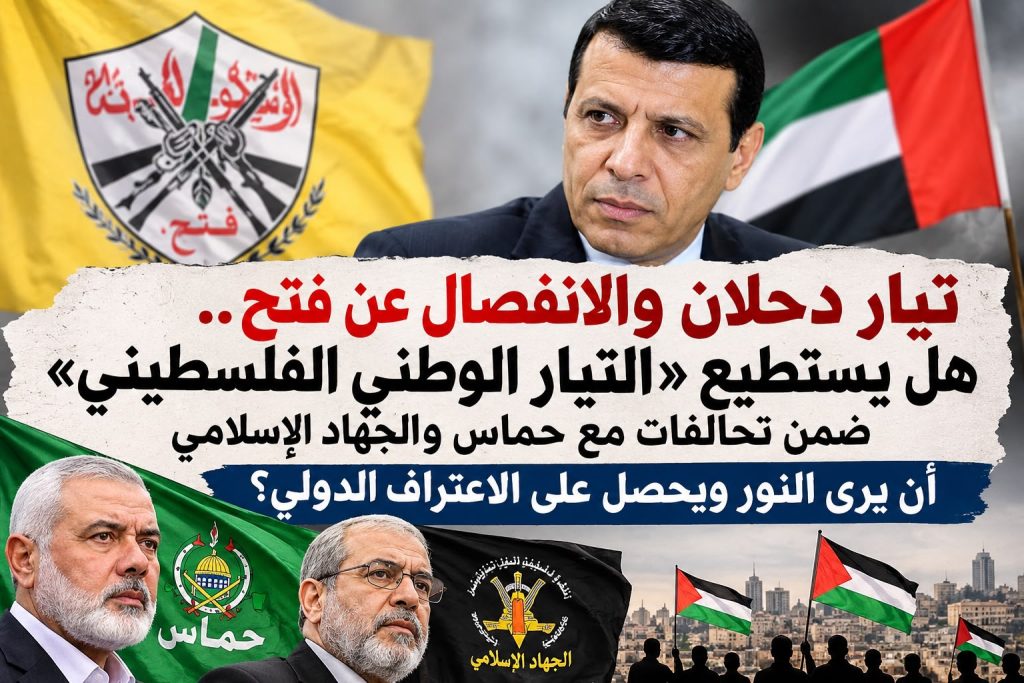
Dahlan’s Faction and the Break from Fatah: Can the “Palestinian National Current”—through alliances with Hamas and the Palestinian Islamic Jihad—emerge and gain international recognition?
Attention is turning toward a new political project that the Democratic Reform Current, led by Mohammed Dahlan, is preparing to launch in early 2027 under the name “Palestinian National Current.” This move could transform the faction from an opposition group within the Fatah movement into an independent political party that extends beyond Fatah’s traditional base.
Organizationally, the faction has developed an institutional structure over the past few years. Since its first conference in 2021—which saw the election of a 64-member council for the Gaza Strip—it has built a network of relief, educational, and civil institutions, alongside a grassroots base and a presence both inside and outside the Gaza Strip, all with clear support from the United Arab Emirates.
What is new about this project, however, is the effort to expand alliances to include independent figures, as well as former leaders from Hamas, the Palestinian Islamic Jihad, and various leftist factions.
This raises the most difficult questions:
Can Dahlan unite these diverse components under a single political platform? Furthermore, will the alliances with Hamas and the Palestinian Islamic Jihad be limited to electoral cooperation, or will they evolve into a permanent political partnership?
Most importantly: Can this project secure international acceptance and recognition, given the involvement of Hamas—an organization designated as a terrorist group by the United Kingdom, the United States, and the European Union?
Another equally significant challenge concerns the support from the UAE. Will Abu Dhabi continue to fund the project once it becomes an independent party? And could the initiative survive if this Emirati financial and political umbrella were to be withdrawn? Palestinian history is replete with instances of factions breaking away from Fatah—some of which possessed funding and external support, yet struggled to endure once that backing from their sponsors waned.
In summary:
While the emergence of a “Palestinian National Current” may not be difficult from an organizational standpoint, the true challenge lies in maintaining an independent political agenda, forging coherent alliances, securing international recognition, and—most importantly—possessing the capacity to survive without total reliance on external donors.
Money may be enough to create a party, but it cannot guarantee it a political future.

